Acupuncture
Acupuncture at the Women's Health Clinic, Clapham, London — what the needles are really like, what a first visit involves, how a session feels, and answers to the questions people usually want to ask.
Acupuncture is one of the oldest continuously practised therapies in the world, and for most people who have never tried it, it is also one of the most mysterious. This page is our attempt to take the mystery out of it — what the needles are actually like, what happens from the moment you arrive, and what the hour feels like.
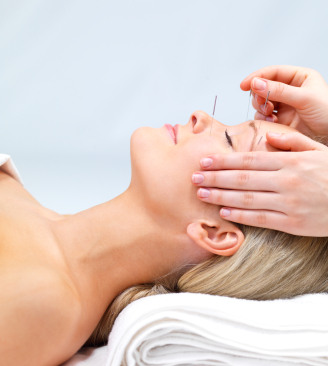
If the needles are what worries you
You would not be the first. A good number of the women who come here arrive saying they are not good with needles, and it is worth knowing how different these are from the ones you are picturing.
An acupuncture needle is solid, not hollow — nothing is injected and nothing is drawn out. It is typically around 0.2 mm across, several times finer than the needle used to take a blood sample, and closer in thickness to a coarse human hair. Most are inserted only a few millimetres.
If you are nervous, say so when you arrive. Dr Zhang can use fewer needles, work only on your arms and legs, show you one first, or simply talk you through each one before it goes in. Nobody here minds, and nothing happens without you knowing it is about to.
How Chinese medicine understands it
Traditional Chinese Medicine is built on the idea that qi — vital energy — moves through the body along channels, or meridians, and that the points used in acupuncture lie along them. A practitioner chooses points according to the pattern she identifies in you, which is why two people who arrive with the same complaint may not get the same points.
That is the framework the tradition works within, and it is the one Dr Zhang was trained in. It is a way of thinking about the body rather than a description of anatomy, and we would rather set it out honestly as that than dress it up as something else.
Your first visit, step by step
- The consultation comes first — usually the longest part of a first appointment. Expect questions that may seem unrelated to why you came: sleep, appetite, digestion, temperature, energy through the day, your cycle, what is going on in your life.
- Pulse and tongue. Dr Zhang will take your pulse at both wrists, feeling at three positions on each, and will ask to look at your tongue. Both are traditional diagnostic methods and neither takes long.
- A conversation about what happens next — what she would suggest, what it would involve, and what she would not suggest. This is the point to ask anything.
- The treatment itself. You lie on a treatment couch, usually face up, covered and comfortable. Points are commonly on the lower arms, lower legs, abdomen, back or head — you will not usually need to undress beyond rolling up sleeves and trouser legs, and you will be covered throughout.
- Rest. Needles stay in for roughly twenty to thirty minutes while you lie quietly. The lights go down. Dr Zhang stays nearby.
- Removal. Taking them out takes a moment and is almost always unnoticeable.
What it actually feels like
Insertion is usually felt as no more than a tap, and quite often not at all. What you may notice a moment later is a dull, heavy, spreading or faintly tingling sensation around the point — practitioners call this de qi, and it usually settles within a few seconds. It should feel odd rather than sharp. Sharp is worth mentioning, and the needle can be adjusted or taken out.
After that, most people find the twenty minutes surprisingly restful. Lying still in a quiet room with nothing being asked of you is not a small thing, and a fair number of our patients fall asleep. People often describe feeling calm afterwards, sometimes pleasantly heavy, occasionally rather alert.
The other techniques you may come across
Depending on what you and Dr Zhang have discussed, a session may include one of these alongside the needles:
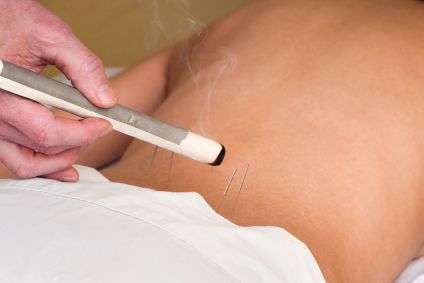
- Moxibustion — the dried herb mugwort, smouldered near a point to warm it. It is held above the skin or placed on the end of a needle; nothing touches you and it should feel pleasantly warm, never hot. It has a distinctive smell, a little like incense.
- Electro-acupuncture — a very small current passed between two needles, felt as a light, rhythmic tapping. The intensity is set by you: if you can feel it clearly and it is comfortable, that is right.
The practical questions people ask
- What should I wear? Something loose that moves easily above the elbow and the knee. Nothing tight around the waist.
- Should I eat first? Yes — have something in the couple of hours beforehand. Arriving very hungry makes light-headedness more likely.
- How long does an appointment take? Allow about an hour.
- Can I drive afterwards? Most people can, but some feel a little spacey for a short while. If it is your first time, it is worth seeing how you feel before planning anything demanding straight afterwards.
- How often? That depends entirely on you and is agreed between you and Dr Zhang — never booked in a block on the first day.
- Can I come during my period? Yes. Do mention where you are in your cycle, as it forms part of the assessment.
- Can I bring someone? Of course — a partner, a friend, or a baby.
- Afterwards — drink some water, go easy on alcohol and hard exercise that evening, and give yourself a gentle rest of the day if you can.
Hygiene and precautions
We use only sterile, pre-sterilised, single-use disposable needles. Each one comes from a sealed package, is used once, and goes straight into a sharps bin — nothing is ever reused. The skin is cleaned before insertion.
Reported side effects are generally minor: occasionally a small bruise at a needle site, a brief moment of light-headedness, or feeling tired afterwards. Tell us at the time if anything feels wrong.
Please tell us before treatment if you are pregnant or think you might be, are taking any medication — particularly anticoagulants — have a pacemaker or other implanted electrical device, have a bleeding disorder, or have lymphoedema. Some of these change where or whether needles are used, and Dr Zhang will decline to treat where she does not think it is appropriate.
What we can and cannot tell you
One more thing, because we would rather be straight with you than vague. We are not able to tell you that acupuncture will treat or relieve a medical condition, and we will not imply it. Everything above is a description of what the treatment is and what coming here is like — which is what we can honestly offer you.
If what you really want to know is what is likely to help a particular problem, your GP is the right person to ask, and we will say so rather than talk you into a course of treatment. We would rather you came here knowing exactly what you are getting.
The same goes once you have started. We review how you are getting on at every visit, and if you are not getting anything out of it, we will tell you rather than keep booking you in.
Still have a question? Call 07884 434178 and ask. A no-obligation chat before you book is genuinely welcome — most people have something they would rather ask in advance.
Watch: an introduction to acupuncture
Video courtesy of the Association of Traditional Chinese Medicine and Acupuncture UK (ATCM), of which Dr Zhang is a member.
Questions before you book?
Call for a friendly, no-obligation chat about what treatment involves, or book a consultation with Dr Zhang.